Every week, homeowners across Sandy and the Salt Lake Valley face the same question: Do I actually need a licensed electrician for this, or can I just call a handyman? It seems simple, but the answer has real legal and financial stakes. Get it wrong and you could be looking at a failed home inspection, a voided insurance claim, or worse — a house fire.
As a licensed Master Electrician operating in Sandy, Utah, I get asked this constantly. So let’s cut through the confusion and look at exactly what Utah law says.
Utah’s Licensing Framework for Electricians
Utah takes electrical licensing seriously. The state’s licensing system is administered by the Division of Occupational and Professional Licensing (DOPL), which falls under the Utah Department of Commerce. There are five recognized license tiers, each carrying a different legal scope of work.
| License Tier | What They Can Do | Experience Required |
|---|---|---|
| Apprentice Electrician | Work only under direct supervision of a Journeyman or Master | Enrolled in an approved apprenticeship program |
| Residential Journeyman | Electrical work on residential properties | 2-year apprenticeship + 4,000 hrs |
| Journeyman Electrician | Residential, commercial & industrial (under Master supervision) | 4-year apprenticeship + 8,000 hrs |
| Residential Master | Plan, supervise & execute all residential electrical work | 4,000 hrs as Residential Journeyman |
| Master Electrician | All electrical work; can pull permits & run a licensed business | 8,000 hrs as Journeyman, or degree + experience |
When a contractor like Westover Electric operates in Utah, the business must hold either an E200 General Electrical Contractor or E201 Residential Electrical Contractor license — and the qualifying individual must hold at minimum a Master Electrician credential. That credential requires passing rigorous theory, code, and practical examinations administered by DOPL.
“A Master Electrician license requires thousands of hours of verified field experience and the passing of state-administered theory, code, and practical exams. It’s not a credential anyone can pick up in a weekend.”
What Can a Handyman Legally Do in Utah?
Utah’s Construction Trades Licensing Act (Utah Code § 58-55) sets the rules for who must be licensed. The short answer for handymen: electrical work is mostly off-limits — but there is a narrow legal carve-out.
Under Utah Administrative Code R156-55b-102, unlicensed individuals are permitted to perform “minor electrical work incidental to a mechanical or service installation” — defined specifically as work where wiring is extended no more than ten feet from an existing outlet or disconnect intended for a specific piece of equipment. The law cites examples like HVAC appliance connections and pre-built hot tub installations.
What a handyman can legally do (electrically):
- Plug-in appliance hookups — connecting a pre-assembled appliance to an existing outlet
- Minor HVAC connections — extending wiring no more than 10 feet from an existing disconnect
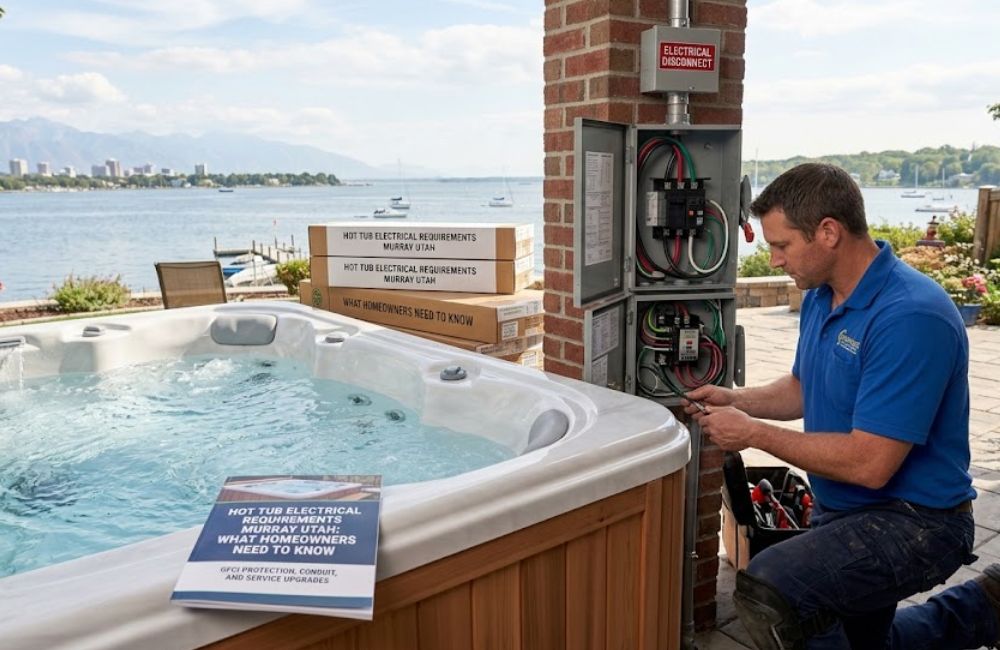
- Above-ground pre-built hot tub installation — the incidental electrical connection only, not new circuits
- Replacing like-for-like fixtures — some basic fixture swaps may qualify; when in doubt, call a licensed electrician
Everything else — new circuits, panel work, wiring extensions beyond ten feet, outlet additions, sub-panel installations, EV charger wiring — requires a licensed electrician. A handyman advertising “full electrical services” in Sandy or anywhere in Utah is operating outside the law.
What Happens When Someone Works Without a License?
Utah Code § 58-55-501 makes it explicitly illegal to hire an unlicensed person to perform construction trade work that requires licensure. And Utah law carries a significant consequence for the unlicensed contractor: they generally cannot sue in Utah courts to recover payment, even if their work was technically sound.
For homeowners, the legal risk runs in the other direction. If something goes wrong — a fire, an injury, a failed inspection — you may be holding the bag.
Risks of hiring unlicensed electrical work:
- Insurance denial — homeowner’s insurance may deny claims for damage caused by unlicensed electrical work
- Failed inspections — unpermitted work will fail building inspections, delaying or killing home sales
- Voided appliance warranties — many manufacturers require licensed installation to honor product warranties
- Homeowner liability — if an uninsured worker is injured on your property, the financial liability often falls on you
- Reduced resale value — buyers and inspectors scrutinize unpermitted electrical work; it can lower your home’s appraised value or kill a deal
- Fire hazard — improper wiring and overloaded circuits are among the leading causes of residential electrical fires
Why Master Electrician Credentials Matter
Not all licensed electricians hold the same credentials. A Journeyman can perform excellent work, but they must do so under the general supervision of a Master Electrician. A Master Electrician — the highest license tier in Utah — has demonstrated through thousands of hours of experience and multiple state exams that they can independently plan, supervise, and execute complex electrical projects.
At Westover Electric, Thomas Westover holds a Master Electrician license and operates as a fully licensed electrical contractor in Sandy, UT. That means every project — whether it’s a panel upgrade, an EV charger installation, or a whole-home rewire — is handled by someone who has met Utah’s highest standard for electrical competency, carries full liability insurance, and pulls all required permits.
When you hire Westover Electric, you’re not just getting electrical work done. You’re getting documentation, permits, and a paper trail that protects your home’s value and your insurance coverage for years to come.
How to Verify an Electrician’s License in Utah
Before hiring any electrician in Sandy or the Salt Lake Valley, verify their license directly through DOPL’s online lookup tool at dopl.utah.gov. Ask any prospective electrician for:
- Their individual electrician license number and classification
- Their contractor license number (E200 or E201)
- A certificate of liability insurance and workers’ compensation coverage
A legitimate, licensed contractor will provide all three without hesitation. If someone is evasive about credentials or offers a quote that seems suspiciously low, that’s often a sign they’re operating without proper licensing or insurance.
The Bottom Line for Sandy, UT Homeowners
Handymen provide real value for a wide range of home maintenance tasks. But for electrical work beyond the narrowest of exceptions, Utah law draws a clear line. Anything involving new wiring, panel upgrades, additional circuits, EV charger installations, or work that requires a permit must be performed by a licensed electrician — ideally one with a Master Electrician credential and a valid contractor license.
If you’re in Sandy, Draper, Midvale, South Jordan, or anywhere in the Salt Lake Valley and you’re unsure whether your project requires a licensed electrician, the safest move is to call one and ask. At Westover Electric, estimates are always free.
Looking for a Master Electrician in Sandy, UT?
When it comes to electrical work in Sandy, UT, experience and credentials matter. Thomas Westover is a licensed Master Electrician — Utah’s highest level of electrical certification — with thousands of hours of verified field experience and the knowledge to handle everything from panel upgrades and EV charger installations to full home rewires. As a fully licensed and insured electrical contractor serving Sandy, Draper, Midvale, South Jordan, and Salt Lake City, Westover Electric brings Master-level expertise to every job, pulls all required permits, and backs every project with professional accountability. Every review is 5 stars. Estimates are always free. If you want the job done right, done safely, and done to code the first time, Westover Electric is the call to make.
Frequently Asked Questions
Do I need a licensed electrician to replace an outlet in my home in Sandy, Utah? Generally, yes. Replacing an outlet is considered “premises wiring” work under Utah’s electrical code, which requires a licensed electrician. Having a licensed professional do the work ensures it’s done correctly, permits are pulled if required, and your homeowner’s insurance remains valid.
Can a handyman legally do electrical work in Utah? Only in a very narrow category: minor electrical work incidental to a mechanical or service installation, where wiring is extended no more than ten feet from an existing outlet or disconnect. New circuits, panel work, EV charger wiring, or any modification to premises wiring requires a licensed electrician under Utah Administrative Code R156-55b-102.
What’s the difference between a Journeyman and a Master Electrician in Utah? A Journeyman Electrician can perform electrical installations but must work under the general supervision of a Master Electrician. A Master Electrician has completed additional years of experience (typically 8,000+ hours as a Journeyman) and passed advanced state exams. Only a Master Electrician can independently run an electrical contracting business, pull permits, and supervise all project types in Utah.
Will my homeowner’s insurance cover damage from unlicensed electrical work? Potentially not. Many homeowners’ insurance policies include provisions that allow claims to be denied if damage is traced to unpermitted or unlicensed work. Hiring a licensed, insured electrician is the safest way to ensure you’re covered. Always check your specific policy language.
Does Westover Electric pull permits for electrical work in Sandy, UT? Yes. As a licensed electrical contractor, Westover Electric pulls all required permits for projects that call for them. This protects homeowners by ensuring the work is inspected and documented — something that becomes critically important when you sell your home or file an insurance claim.
How do I verify a Utah electrician’s license? You can verify any electrician or electrical contractor’s license through the Utah Division of Occupational and Professional Licensing (DOPL) at dopl.utah.gov. Search by license number or name. Always ask for both the individual electrician’s license and the company’s contractor license (E200 or E201) before any work begins.
Sources & References
- Utah Department of Commerce, DOPL — https://commerce.utah.gov/dopl/electrical/
- Utah DOPL — Residential Journeyman Electrician Requirements: https://dopl.utah.gov/electrical/apply-for-a-license/residential-journeyman-electrician/utah-applicants/
- Utah DOPL — Residential Master Electrician Requirements: https://commerce.utah.gov/dopl/electrical/apply-for-a-license/residential-master-electrician/utah-applicants/
- BEA Contractor — Utah E200 & E201 Licenses: https://beacontractor.com/utah-e200/
- Utah Admin. Code R156-55b-102: https://www.law.cornell.edu/regulations/utah/Utah-Admin-Code-R156-55b-102
- Utah Code § 58-55-501: https://le.utah.gov/xcode/Title58/Chapter55/58-55-S501.html
- Skoubye, Nielson & Johansen: https://snjlegal.com/2023/01/11/what-happens-when-a-utah-contractor-works-without-a-license/
- Thomas Edison Electric: https://thomasedisonelectric.com/tips/safety/the-liability-of-unlicensed-electrical-work
- PRO Electric: https://proelectricva.com/50-challenges-unlicensed-electricians-can-cause-for-homeowners/