ADU electrical requirements in Murray, Utah are one of the first things homeowners run into when they start planning an accessory dwelling unit—and one of the last things they expect to be complicated. The idea is straightforward enough: convert the basement, build above the garage, or add a detached unit in the backyard to house a family member, generate rental income, or add long-term value to the property. Execution involves much more than most people plan for.
I’ve done the electrical on ADU projects across Murray, Salt Lake City, Millcreek, and Salt Lake County. The electrical scope on these jobs surprises homeowners more consistently than almost anything else. Not because the work is exotic — it isn’t — but because Utah building code treats ADUs as new habitable space, which means the electrical must meet current standards from scratch, regardless of what the existing home has.
This post covers what Utah code requires for ADU electrical, common surprises, and how to plan for them before you’re mid-project.
What Counts as an ADU in Murray and Salt Lake City
An ADU — accessory dwelling unit — is a self-contained residential unit on the same lot as a primary single-family home. Utah’s 2021 ADU law, passed as HB 82 and codified at Utah Code 10-9a-530, made the internal accessory dwelling unit a permitted use in most residential zones. An internal ADU is one created within the existing footprint of the home — a basement apartment, a converted garage, an in-law suite on the main level. homie
On June 4, 2024, Salt Lake County adopted an ordinance to reduce restrictions to facilitate greater ADU adoption by residents. That ordinance made it meaningfully easier to add ADUs across unincorporated Salt Lake County. Murray City and Salt Lake City each have their own ADU ordinances that align with state law while adding local requirements — always confirm specifics with the relevant planning department before you start. saltlakecounty
What all ADUs have in common, regardless of type, is this: ADUs are subject to building code requirements, utility requirements, fire codes, and other applicable regulations that apply to all new buildings and additions. The electrical work on an ADU isn’t evaluated as a simple remodel — it’s evaluated as a new dwelling unit, with all the requirements that come with that. slcdocs
The Core Electrical Requirements for Every ADU in Salt Lake County
A Separate Electrical Disconnect
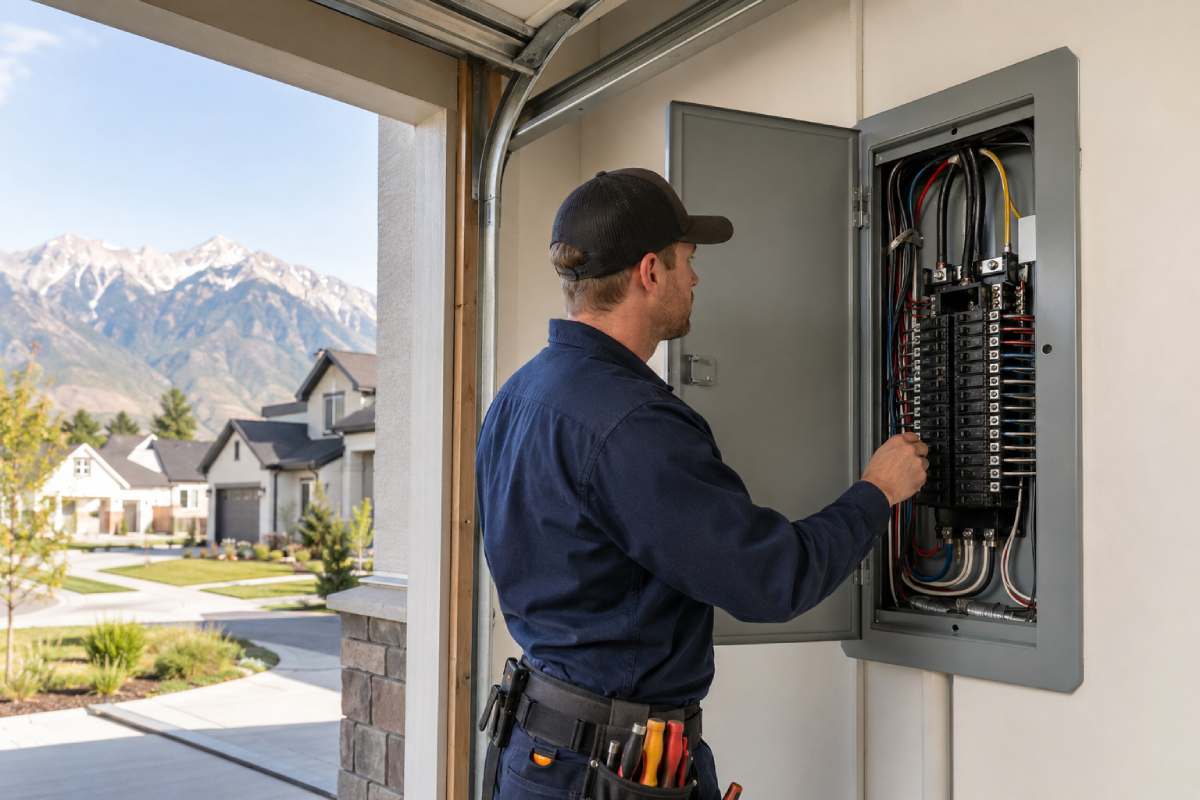
Each mechanical system or electrical panel must be independently accessed for service from the respective dwelling unit. Separate and accessible power disconnects are required. This means the ADU needs its own disconnect that can be shut off independently from the primary home — not just a shared breaker in the main panel. For a basement ADU, this is typically a subpanel installed in or adjacent to the ADU space. For a detached ADU, it’s a separate panel fed from the main service. slcdocs
This requirement exists for good reason: if the ADU is rented, the tenant needs to control and shut off power to their unit without access to the primary home’s panel. And if there’s an emergency in the ADU, the relevant circuits need to be identifiable and shutoff-able without cutting power to the entire property.
Panel Capacity Assessment
Before any ADU electrical work begins, you need to assess your main panel’s capacity. A detached ADU adds a new load to your service—and depending on the unit’s size, HVAC setup, and appliances, that load can be significant. Internal ADUs cannot have separate utility meters. Detached ADUs may be separately metered so long as the property owner receives the bills for both units. saltlakecounty
For most Murray and Salt Lake City homeowners with 100-amp service, adding an ADU — especially a detached one — requires a panel upgrade to 200-amp service before the project can proceed. This is one of the most common surprises in ADU electrical planning and one of the most important things to assess before any other planning or contractor commitments.
GFCI and AFCI Protection
ADUs must meet current NEC requirements for GFCI and AFCI protection, which means current-code coverage regardless of when the rest of the house was built. Install GFCI outlets in kitchens and bathrooms. AFCI protection is required on bedroom circuits and most general-purpose circuits in habitable space — the same requirements that apply to new construction. nslcity
This matters because many basement conversions in Murray and Salt Lake City involve wiring that predates modern GFCI and AFCI requirements. Bringing the ADU space up to current code means new circuits, new breakers, and new devices — not just extending what’s already there.
Smoke and Carbon Monoxide Detectors
Each bedroom must have a working smoke detector, and hallways outside bedrooms must have a working smoke detector and a CO detector. These must be hardwired and interconnected in an ADU — not battery-only. The interconnection requirement means that when one detector triggers, all detectors in both the ADU and the primary dwelling activate. This life-safety requirement is verified by inspectors before issuing a certificate of occupancy. nslcity
Dedicated Circuits for Kitchen and Laundry
Every ADU kitchen needs at least two dedicated 20-amp small-appliance circuits for countertop receptacles, plus a dedicated circuit for the refrigerator. If the ADU includes laundry, you need a dedicated 240-volt circuit for the dryer and a dedicated 20-amp circuit for the washer. These can’t share breakers with general lighting or outlet circuits — they have to be independent from the main panel or subpanel.
Lighting in Every Habitable Room
A switched lighting outlet is required in every habitable room, hallway, stairway, and bathroom. Just like a basement finish, an ADU can’t rely on plug-in lamps for primary room lighting — every space needs a hardwired, switch-controlled light.
Detached ADU Electrical: The Additional Requirements
A detached ADU — a standalone structure in the backyard, above a garage, or as a new build — has additional electrical requirements beyond the interior conversion requirements above.
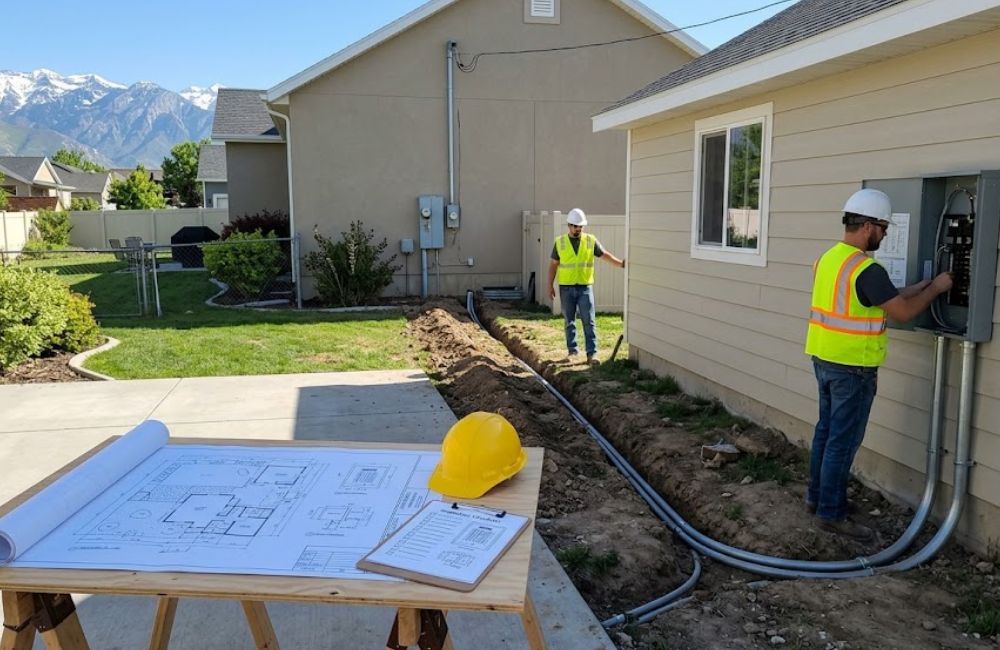
Underground service run. Power has to get from the main panel to the detached structure. This means an underground conduit run — typically rigid PVC buried at the code-required depth of 18 inches for PVC conduit — between the main house and the ADU. The length of this run is one of the biggest variables in detached ADU electrical cost. A structure 10 feet from an attached garage with a modern 200-amp panel is a short, simple run. A structure at the back of a large Murray lot, across landscaping and a concrete patio, is a significantly more involved job.
Separate subpanel. A detached ADU needs its own subpanel — a distribution panel fed from the main panel that provides circuit protection and disconnect capability for the structure. The subpanel size depends on the ADU’s load: a small studio needs far less than a full one-bedroom unit with HVAC, laundry, and a kitchen.
Exterior GFCI outlets. Any exterior outlets on the detached structure — including porch outlets and garage outlets — must be GFCI-protected per NEC requirements.
Do You Need a Permit for ADU Electrical Work in Murray or Salt Lake City?
Yes — without exception. You need a building permit before constructing or converting to an ADU. All ADUs must comply with applicable building, fire, and health codes. The electrical permit is part of the broader ADU building permit process and requires inspection at rough-in and final stages — the same two-inspection process as any new construction electrical. saltlakecounty
Skipping the permit on ADU electrical creates the same problems it creates everywhere else—insurance exposure, resale complications, and potential removal orders—with the added risk that an unpermitted ADU in Salt Lake County can be deemed illegal and the rental income stopped.
In Murray City and Salt Lake City, the ADU permit process involves both planning and building departments. A licensed electrical contractor handles the electrical permit application as part of the project — at Westover Electric, permitting is included in every ADU electrical project we take on.
What ADU Electrical Work Actually Costs in Salt Lake County
ADU electrical scope varies more than almost any other residential electrical project, because the variables — panel capacity, unit size, detached vs. internal, distance from the main panel — are so significant. That said, here’s what typical components cost in the Salt Lake County market in 2026:
Panel upgrade (100-amp to 200-amp): $1,500–$3,800 installed and permitted — often required before ADU work can begin on older Murray homes.
Subpanel installation for internal ADU: $800–$1,500 installed and permitted, depending on location and distance from the main panel.
Underground service run for detached ADU: $500–$2,000+ depending on distance, conduit complexity, and any hardscape or landscaping in the path.
Full electrical rough-in for ADU space: $2,000–$6,000+ depending on unit size, number of circuits, and existing infrastructure.
Total electrical scope for a typical internal ADU in Murray: $3,000–$8,000 depending on the condition of the existing panel and how much of the space has existing wiring.
Total electrical scope for a detached ADU: $5,000–$15,000+ depending on distance, panel upgrade requirements, and unit size.
These ranges are real — Westover Electric provides free estimates with upfront, transparent pricing on every ADU project. The right number for your specific property depends on an on-site assessment, not a ballpark.
Frequently Asked Questions
Do I need a separate electrical panel for my ADU in Murray or Salt Lake City?
Yes. Utah building code requires a separate, accessible disconnect for each dwelling unit. For an internal ADU, this is typically a subpanel in or adjacent to the ADU space. For a detached ADU, it’s a separate subpanel in the structure. The subpanel is fed from the main panel and provides independent circuit protection and shutoff capability for the ADU.
Can I use my existing 100-amp panel to add an ADU in Murray?
Possibly, but probably not without an upgrade. Whether a 100-amp panel can support an ADU depends on your current load and the ADU’s planned load. Most Murray and Salt Lake City homes with 100-amp service already run near capacity with modern appliances and HVAC, so adding an ADU typically requires a 200-amp upgrade. A licensed electrician can assess your current panel load before you make any other commitments.
Is ADU electrical work different from a basement finish?
Yes — more involved. A basement finish adds circuits and devices within your existing dwelling. An ADU creates a separate dwelling unit with its own disconnect, circuit capacity, HVAC requirements, and kitchen and laundry electrical. The code treats it as new habitable space from scratch, not a remodel of existing space.
Can I do my own ADU electrical work in Utah?
Utah law allows homeowners to do electrical work on their primary residence with a permit and inspection. ADU electrical work on your own property falls under this allowance — but the work still has to be permitted, inspected, and done to code. For most homeowners, the scope and complexity of ADU electrical makes professional installation the practical choice. Any work done by someone other than the licensed homeowner requires a licensed electrical contractor.
How long does ADU electrical work take in Salt Lake County?
Most ADU electrical projects in Murray and Salt Lake City take two to five days of field work plus permit processing time. Salt Lake County permits typically take one to three weeks to process. Westover Electric handles all permitting as part of every ADU project — factor the permit window into your overall project timeline from the beginning.
Does Westover Electric handle ADU electrical work in Murray and Salt Lake City?
Yes. Westover Electric serves Murray, Salt Lake City, Millcreek, Sandy, Midvale, South Jordan, Draper, and throughout Salt Lake County. We handle the full ADU electrical scope — panel assessment and upgrades, subpanel installation, underground service runs, full circuit rough-in, GFCI and AFCI protection, smoke and CO detector installation, permits, and inspections. Call (385) 732-3182 or request a free estimate online.
Looking for a Master Electrician in Murray or Salt Lake City?
When it comes to ADU electrical requirements in Murray, Utah, getting the electrical scope right from the start keeps a project on schedule and on budget. Thomas Westover is a licensed Master Electrician — Utah’s highest level of electrical certification — with the hands-on experience to assess your panel, plan the full electrical scope, and execute every phase of ADU electrical work to code throughout Salt Lake County. As a fully licensed and insured electrical contractor serving Murray, Salt Lake City, Sandy, Midvale, South Jordan, and Draper, Westover Electric handles every phase from panel evaluation through permit and final inspection. Every review is 5 stars. Estimates are always free.
Sources & References
- Salt Lake County — Accessory Dwelling Units (ADUs): https://www.saltlakecounty.gov/regional-development/planning-transportation/accessory-dwelling-units-adus/
- Salt Lake City — ADU Handbook: https://www.slcdocs.com/Planning/Guides/ADU_handbook.pdf
- Homie — Utah ADU Laws in 2026: https://www.homie.com/utah-adu-laws-in-2026-what-the-internal-accessory-dwelling-unit-statute-allows/
- North Salt Lake City — Accessory Dwelling Units Requirements: https://www.nslcity.org/519/Accessory-Dwelling-Units
- West Jordan City — ADU Application and Requirements: https://www.westjordan.utah.gov/wp-content/uploads/2026/03/ADU-APPLICATION-updated-9.18.2025.pdf
- Greater Salt Lake Municipal Services District — ADU Checklist: https://msd.utah.gov/DocumentCenter/View/423/Accessory-Dwelling-Unit_ADU-Checklist_Fillable-PDF-2025
- National Fire Protection Association — NFPA 70 National Electrical Code: https://www.nfpa.org/codes-and-standards/nfpa-70-standard-development/70
- Utah Division of Occupational and Professional Licensing (DOPL): https://commerce.utah.gov/dopl/electrical/