Hot tub electrical requirements in Murray, Utah are the part of the purchase that catches most homeowners completely off guard. You’ve picked out the tub, figured out where it’s going in the backyard, and the retailer has a delivery date locked in — and then someone mentions a dedicated circuit, a disconnect box, a GFCI breaker, conduit burial depth, and a permit. Suddenly, you have an entire project you didn’t plan for.
It happens constantly across Salt Lake County. The hot tub arrives. The electrician hasn’t been called yet. The tub sits in the yard for a week waiting on electrical work that should have been lined up well before delivery day.
I’ve done hot tub electrical installations across Murray, Salt Lake City, Millcreek, Sandy, and the wider Salt Lake Valley. The same questions come up every single time. This post answers all of them — what the code requires, what each component does, what it costs, and how to make sure it’s done right before anyone gets in the water.
Why Hot Tub Electrical Is More Involved Than Most Homeowners Expect
A hot tub isn’t like plugging in an appliance. Most permanent hot tubs run on 240 volts and draw 50 to 60 amps continuously—the same kind of load as a central air conditioning unit or an electric dryer —except the hot tub runs that load around the clock to maintain water temperature.
Because water and electricity are directly adjacent in a hot tub installation, the National Electrical Code treats spas and hot tubs under a dedicated section—NEC Article 680—with requirements that go well beyond standard outdoor electrical work. Improper hot tub wiring can cause severe hazards, from electric shock to fire, and the code reflects that reality with specific, non-negotiable requirements.
In Utah, all hot tub wiring must comply with NEC Article 680 plus state and local amendments. Murray and Salt Lake City both follow the adopted state code, which means every component of the installation—from the breaker in the panel to the final connection at the tub—must meet specific requirements and pass inspection before the spa can legally be used.
What Utah Code Actually Requires for a Hot Tub Electrical Installation
Here is what NEC Article 680 requires for every permanent hot tub installation in Murray and Salt Lake City:
A Dedicated 240-Volt Circuit
Your hot tub needs its own circuit. Most 240-volt models require a dedicated 50-amp or 60-amp circuit with a two-pole GFCI breaker. This circuit serves only the hot tub — it cannot share power with patio lights, an outdoor kitchen, a shed, or any other load. A 50-amp breaker is the most common for mid-size tubs. Larger tubs with multiple pumps and heaters may require 60 amps. Your tub’s data plate lists the exact amperage requirement, and your electrician will confirm it before any work begins.
A GFCI-Protected Disconnect Box
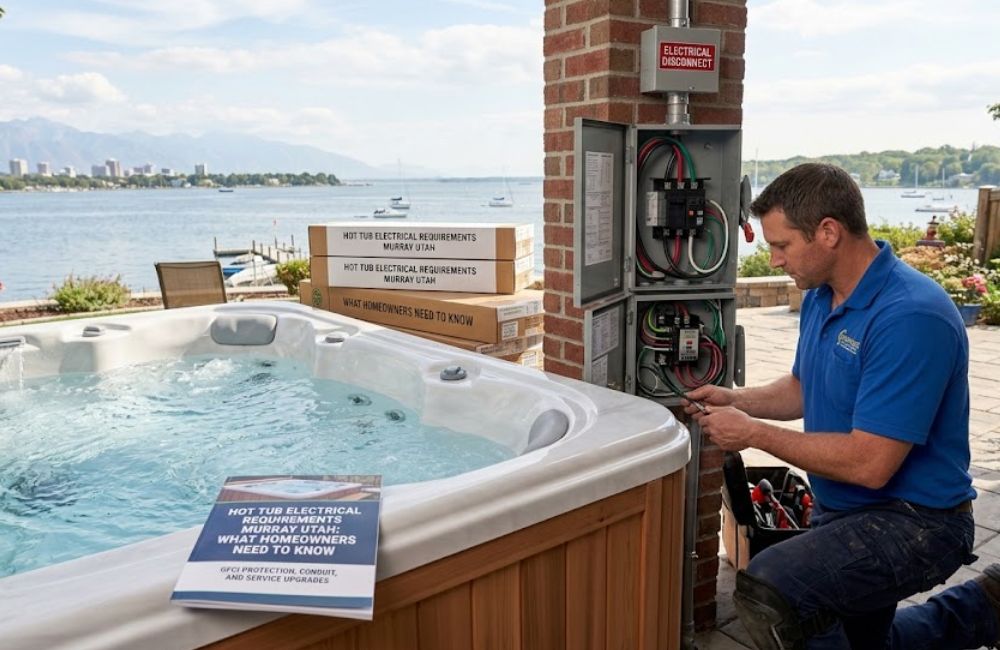
A maintenance disconnect switch must be installed within sight of the hot tub — no closer than 5 feet and no farther than 50 feet from the tub’s edge per NEC 680.12. This allows for quick power cutoff during emergencies or service calls. The disconnect must be lockable in the open position. GFCI protection is commonly built directly into the outdoor disconnect enclosure—50- and 60-amp GFCI-protected disconnecting switches are standard for residential hot tub installations in Utah.
Correct Wire Gauge and Conduit
For a typical 50-amp spa, you need 6 AWG copper wire in a 4-wire system—two hots, one neutral, and one ground. The wiring must be rated for wet and outdoor environments. Outdoor wiring must be protected in conduit—typically rigid PVC—and buried to the proper depth, generally 18 inches for PVC conduit, to prevent damage from lawn equipment, freeze-thaw cycles, and general outdoor exposure.
A GFCI-Protected Convenience Receptacle
NEC Article 680 also requires at least one 125-volt, 15- or 20-amp GFCI-protected convenience receptacle located between 6 and 20 feet from the inside wall of the hot tub. No receptacles are permitted within 6 feet of the tub’s inside wall. This is the outlet near your spa for phone chargers, speakers, or accessories — and it must be GFCI-protected without exception.
Proper Switch and Outlet Setback Distances
Wall switches must be at least 5 feet horizontally from the inside wall of the hot tub per NEC 680.43. No underground wiring is permitted under or within 5 feet horizontally of the hot tub other than the wiring necessary to supply the unit itself per NEC 680.10. The tub also cannot be installed under or within 10 feet horizontally of overhead conductors that are less than 22.5 feet above the highest water level.
Equipotential Bonding
All metal components associated with the hot tub — the shell, pump, heater, lighting, and any metal within 5 feet of the water — must be bonded together to eliminate voltage differences that could cause shock. This is one of the most commonly skipped steps in unpermitted installations and one of the most important safety requirements in Article 680.
Does Your Panel Have Room for a Hot Tub?
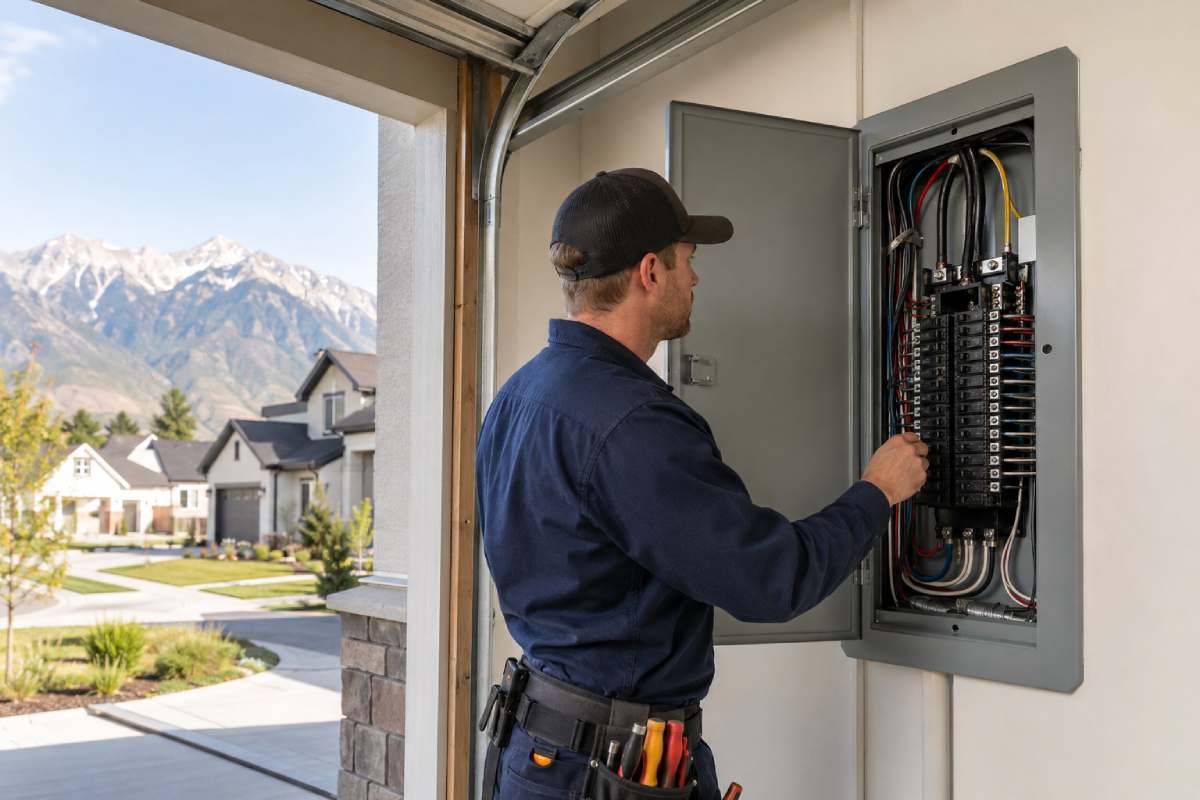
Before any of the above work begins, we need to assess your electrical panel. A hot tub draws a significant continuous load, and your panel needs the capacity to support it.
Older homes in Murray and Salt Lake City—especially those built before 1990—often have 100-amp service panels that are already near capacity. Adding a 50-amp dedicated circuit to an already-loaded 100-amp panel isn’t always possible without first upgrading the service. A licensed electrician evaluates your current panel capacity before committing to any installation scope — and at Westover Electric, that assessment is part of every hot tub electrical consultation.
If your panel does need upgrading before the hot tub can go in, that work needs to happen first. Building it into the project timeline from the beginning prevents delays after the tub has already been delivered.
Do You Need a Permit for Hot Tub Electrical Work in Murray or Salt Lake City?
Yes — without exception. Hot tub electrical installations in Salt Lake County require an electrical permit. Skipping the permit carries consequences that significantly outweigh any perceived time savings: your homeowner’s insurance may deny claims related to the installation, a future home sale inspection will flag the unpermitted work, and your local authority can issue a removal order requiring the installation to be redone from scratch.
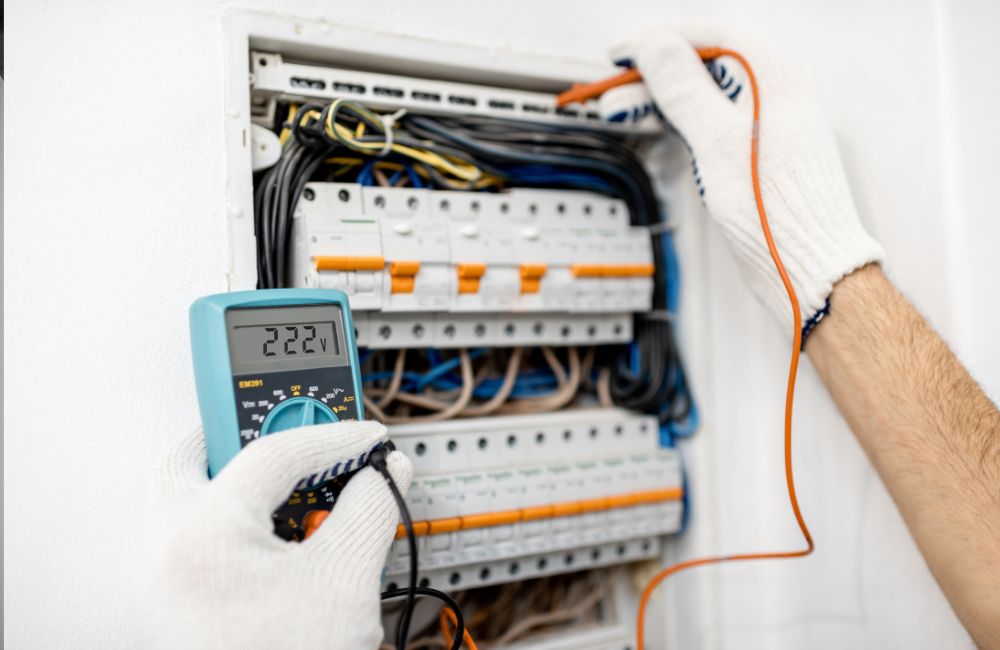
The permit process in Salt Lake County typically costs $50–$200 and takes a few days to a week. The inspection happens after work is complete — an inspector verifies that GFCI protection is present, the disconnect is correctly placed, buried conduit meets depth requirements, and all metal components are properly bonded. The tub can’t be used until this inspection passes.
At Westover Electric, we handle permits for every hot tub installation we complete. It’s part of the job, not an add-on.
What It Costs to Wire a Hot Tub in Murray, Utah
Hot tub electrical installation costs in Salt Lake County typically run $800–$2,000 for most residential properties. The biggest variables are:
Distance from the panel. Every foot of conduit run between your main panel and the hot tub location adds material and labor costs. A tub going in next to an attached garage with a direct panel run is on the lower end. A tub at the far end of a large backyard, or on the opposite side of the house from the panel, pushes the cost higher.
Conduit burial. The longer and more complex the underground conduit run, the more labor is involved. Rocky terrain, concrete patios, or landscaping in the run’s path add time and cost.
Panel capacity. If your panel needs an upgrade before the hot tub circuit can be added, that work is a separate cost—typically $1,500–$3,800 for a standard 100-amp to 200-amp upgrade in Salt Lake County.
Existing wiring infrastructure. Homes that already have a subpanel near the backyard, or a recent 200-amp upgrade with available breaker space, are in much better shape than homes starting from scratch with a full panel and a long run to the back of the property.
Westover Electric provides free estimates with transparent, upfront pricing on every hot tub electrical installation. You’ll know the full cost before any work begins.
What You Should Line Up Before the Hot Tub Is Delivered
The single most common mistake Murray and Salt Lake City homeowners make with hot tub purchases is calling an electrician after the tub has already arrived. Here’s the right order of operations:
Before you finalize the purchase — confirm the tub’s electrical requirements from the spec sheet and have a licensed electrician assess your panel capacity and the proposed installation location. This tells you whether you need a panel upgrade and gives you a realistic cost and timeline before you’re committed.
After you finalize the purchase but before delivery — schedule the electrical work. In Salt Lake County, permit processing takes a few days to a week, rough-in work needs to be done before the tub arrives, and inspection scheduling adds time. Most hot tub electrical installations take one to two days of work plus inspection.
By delivery, the electrical rough-in should already be complete. The electrician makes the final connection to the tub after it’s in place, inspection is scheduled, and you’re cleared to use it.
Getting this sequence right means no tub sitting in your yard. Getting it wrong is expensive and stressful.
Frequently Asked Questions
What size breaker does a hot tub need in Murray or Salt Lake City?
Most residential hot tubs in Salt Lake County require a dedicated 50-amp two-pole GFCI-protected breaker. Larger tubs with multiple pumps and heaters may require 60 amps. The exact requirement is on your tub’s data plate — always wire to the manufacturer’s specifications. A licensed electrician confirms the correct amperage before any work begins.
How far does the disconnect box need to be from the hot tub?
Per NEC 680.12, the disconnect must be within sight of the hot tub, located at least 5 feet but no more than 50 feet from the tub’s inside wall. It must be readily accessible and lockable in the open position for maintenance and emergencies.
Can I plug a hot tub into a regular outdoor outlet?
Plug-and-play 120-volt hot tubs can connect to a standard GFCI-protected outdoor outlet, but these units are significantly underpowered for Utah’s climate. They take much longer to heat, struggle to maintain temperature in winter, and are generally unsuitable for year-round use in Murray or Salt Lake City. For any permanent, full-size hot tub, a dedicated 240-volt circuit is the only practical choice.
Do I need a permit to wire a hot tub in Salt Lake County?
Yes. Hot tub electrical installations require a permit in Murray, Salt Lake City, and throughout Salt Lake County. Unpermitted work can void your homeowner’s insurance, create complications at resale, and result in a removal order from the local authority. Westover Electric handles all permitting on every hot tub electrical project we take on.
How much does hot tub electrical installation cost in Murray, Utah?
Most hot tub electrical installations in Salt Lake County run $800–$2,000 installed and permitted, depending on distance from the panel, conduit complexity, and whether a panel upgrade is needed. Westover Electric provides free estimates with clear, upfront pricing before any work begins.
Does Westover Electric install hot tub electrical in Murray and Salt Lake City?
Yes. Westover Electric serves Murray, Salt Lake City, Millcreek, Sandy, Midvale, South Jordan, Draper, and throughout Salt Lake County. We handle the full hot tub electrical installation, including panel assessment, dedicated circuit, GFCI disconnect, conduit burial, bonding, permits, and final inspection. Call (385) 732-3182 or request a free estimate online.
Looking for a Master Electrician in Murray or Salt Lake City?
Hot tub electrical work in Murray, Utah, isn’t a job for a handyman or an unlicensed contractor. Water and electricity demand professional expertise and proper permitting. Thomas Westover is a licensed Master Electrician — Utah’s highest level of electrical certification — with hands-on experience completing hot tub electrical installations throughout Salt Lake County that pass inspection the first time. As a fully licensed and insured electrical contractor serving Murray, Salt Lake City, Sandy, Midvale, South Jordan, and Draper, Westover Electric handles every phase of the installation from panel assessment through permit and final inspection. Every review is 5 stars. Estimates are always free. If you’re buying a hot tub and want the electrical done right before it’s delivered, that’s the call to make.
Sources & References
- West Valley City, UT — Hot Tub Rules (NEC 680 Local Application): https://www.wvc-ut.gov/300/Hot-Tub-Rules
- JADE Learning — Pool and Spa Wiring Part II, NEC Article 680: https://www.jadelearning.com/blog/pool-and-spa-wiring-part-ii/
- Nassau National Cable — NEC Article 680 on Pools, Spas, and Water-Based Installations: https://nassaunationalcable.com/blogs/blog/explaining-nec-article-680-on-pools-spas-and-water-based-installations
- OneHotTub — Hot Tub Electrical Installation NEC Code Guide 2026: https://onehottub.com/hot-tub-electrical-installation/
- Black Rhino Electric — GFCI Hot Tub Wiring: https://blackrhinoelectric.com/blog/the-ultimate-hot-tub-gfci-wiring-handbook-from-breaker-to-bliss/
- Energy Co Electrical — Spa Disconnect Wiring Guide: https://energycoelectrical.com/hook-up-your-hot-tub-disconnect-box-the-right-way/
- National Fire Protection Association — NFPA 70 National Electrical Code Article 680: https://www.nfpa.org/codes-and-standards/nfpa-70-standard-development/70
- Utah Division of Occupational and Professional Licensing (DOPL): https://commerce.utah.gov/dopl/electrical/