Knowing how to read your electrical panel in Murray, Utah is one of those things every homeowner should understand — and almost nobody does until something goes wrong. The panel is right there, usually in a utility room, basement, or garage, and most people open it once every few years when a breaker trips and they have no idea what they’re looking at.
That’s completely normal. Electrical panels aren’t explained to you when you buy a home. Nobody hands you a guide. And if your labels are faded, handwritten by someone who moved out fifteen years ago, or just say things like “misc” and “upstairs” — you’re not alone.
I’ve been inside hundreds of electrical panels across Murray, Salt Lake City, Millcreek, and the wider Salt Lake Valley. Here’s the plain-language breakdown I give homeowners who want to actually understand what they’re looking at.
What an Electrical Panel Actually Is
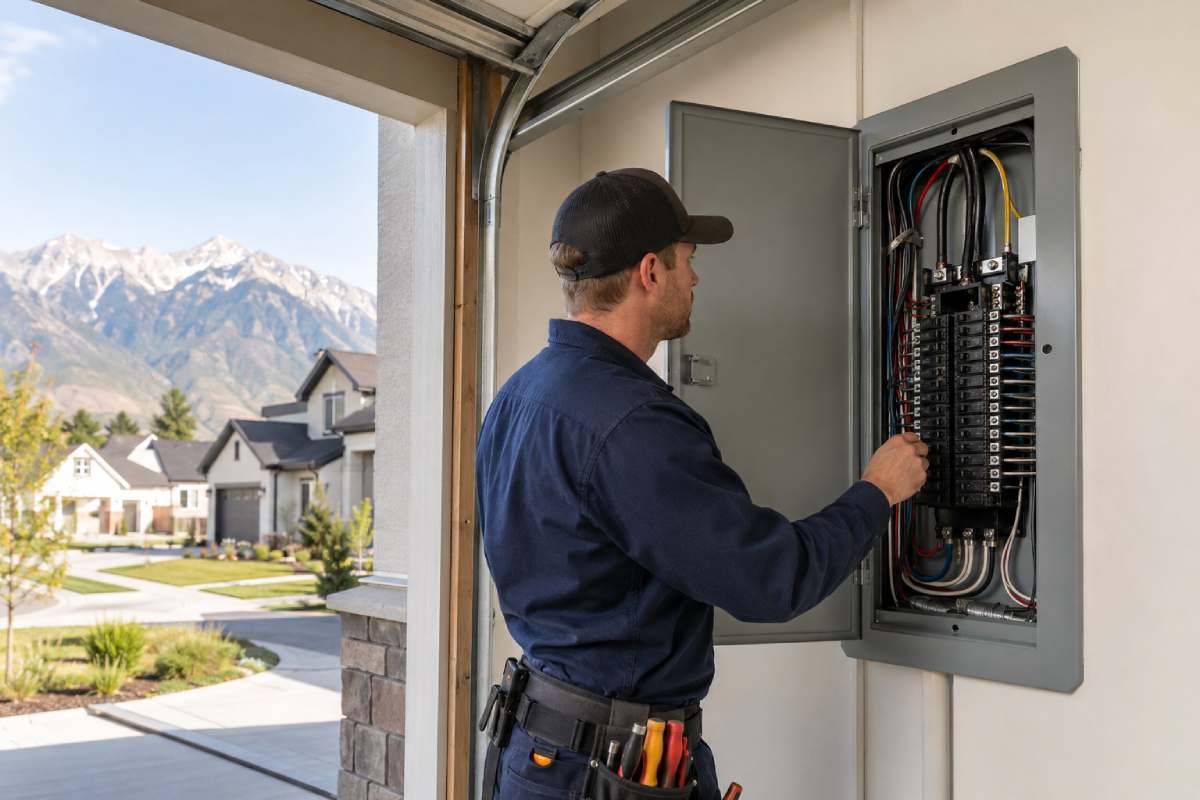
Your electrical panel — also called a breaker box, breaker panel, or load center — is the command center for every circuit in your home. It’s where power from Rocky Mountain Power enters your house and gets distributed out to every outlet, light fixture, appliance, and circuit throughout the building.
Inside, you’ll find breaker switches that control electricity to different areas like your kitchen, bathroom, garage, or HVAC system. These breakers also protect your home by tripping during overloads, arc faults, or short circuits. The Electricians
Understanding it isn’t just useful for emergencies — it’s the foundation for knowing whether your home’s electrical system is healthy, whether it has capacity for new circuits, and when it’s time to call a licensed electrician.
The Parts of Your Panel and What They Do
Open the metal door on your panel and you’ll see a few distinct components. Here’s what each one is:
The Main Breaker
The main breaker is the most important switch in your panel. In case of an emergency, you can shut off power to the entire house by flipping the main breaker to the OFF position. Located at the top or bottom of the panel, the main breaker may have a wider switch or a single switch for two separate breakers. Mr. Electric
The number on the main breaker — typically 100, 150, or 200 — is your home’s total amperage capacity. This is the single most important number in the panel. A 100-amp main breaker means your home has 100-amp service. A 200-amp main means 200-amp service. For most modern Murray and Salt Lake City homes, 200-amp service is the standard — older homes may still have 100-amp service, which often isn’t enough for today’s electrical demands.
The Branch Circuit Breakers
Branch circuit breakers are rows of smaller switches that control specific areas or devices. Each one feeds a specific circuit in your home — the kitchen outlets, the master bedroom lights, the garage, the HVAC unit, and so on. Single-pole breakers occupy one slot and handle 120-volt circuits. Double-pole breakers occupy two slots side by side and handle 240-volt circuits for larger loads like dryers, water heaters, EV chargers, and air conditioning units. Mr. Electric
The Amperage Numbers
Every branch breaker has a number stamped on it — most commonly 15, 20, 30, 40, or 50. This number represents the amperage rating of that particular circuit. A 15-amp breaker is suitable for lighting and general-purpose outlets, while a 30-amp breaker might be used for larger appliances like ovens or air conditioners. Brase Electrical
The Directory or Label Chart
Most panels have a small paper chart inside the door listing which breaker controls which area of the home. In a perfect world, this is filled out accurately and legibly. In the real world — especially in older Murray and Salt Lake City homes — it’s often incomplete, wrong, or completely blank. We’ll get to how to fix that.
Bus Bars
These metal bars distribute electricity from the main breaker to the individual circuit breakers. You won’t need to interact with them directly, but understanding they exist helps explain why all your breakers connect back to a central point. Brucelectric
How to Read the Breaker Positions
Every breaker in your panel is in one of three positions:
ON — The switch is facing towards the center of the box, meaning electrical flow is uninterrupted. The circuit is live and functioning normally. Rytec Electric
OFF — The switch is facing towards the outside of the box, indicating that the circuit is disconnected. Power to that circuit is intentionally cut. Rytec Electric
TRIPPED — The breaker has moved to a middle position between ON and OFF. This is the panel telling you something went wrong on that circuit — an overload, a short circuit, or a fault. A tripped breaker won’t reset until you push it fully to OFF first, then back to ON. If the breaker continues to trip after resetting, there could be a deeper issue with the circuit. It’s best to call a professional to avoid further damage or risk. Mr. Electric
How to Map and Label Your Panel the Right Way
If your panel directory is blank, wrong, or unreadable, mapping it out is one of the most useful things you can do as a homeowner. Here’s how to do it properly:
Test the breakers by flipping each one to the OFF position and then back ON, noting which areas of the house — lights, outlets, appliances — lose power. Once you’ve identified what each breaker controls, label it clearly on your panel. Mr. Electric
A few tips that make this easier in practice:
Use a plug-in lamp or a radio to identify outlet circuits — plug it in, flip breakers one at a time, and note which one kills it. For hardwired fixtures like ceiling lights, having a second person in the room speeds things up considerably.
Be specific with your labels. “Kitchen” isn’t nearly as useful as “Kitchen outlets — north wall” or “Dishwasher dedicated.” The more specific the label, the more useful it is when something goes wrong at 10pm and you’re trying to find the right breaker fast.
Double-pole breakers serve one appliance or circuit — your dryer, oven, water heater, AC unit, or EV charger each get their own double-pole breaker. Label these with the specific appliance, not just the room.
Note any AFCI or GFCI breakers. Some breakers labeled AFCI (Arc Fault Circuit Interrupter) and GFCI (Ground Fault Circuit Interrupter) provide additional safety by detecting and preventing electrical faults. These will have a small TEST button on the breaker face itself. They’re important safety devices — note them in your directory and test them annually. Brase Electrical
What Your Panel Can Tell You About Your Home’s Electrical Health
Once you know how to read a panel, you can start spotting things that warrant a closer look. Here are the warning signs I see regularly in Murray and Salt Lake City homes:
Double-tapped breakers. This is where two wires are connected to a single breaker terminal that’s only rated for one. It’s a code violation in most cases and a sign that someone added circuits without proper capacity planning. If you see two wires going into one breaker, that needs to be addressed.
A panel that’s completely full. If every slot is occupied and there are no open spaces, your panel has no room for new circuits. Adding an EV charger, a hot tub, a basement finish, or any significant new load means either a panel upgrade or a subpanel — there’s no shortcut around it.
Breakers without labels. Unknown circuits are a real problem during an emergency and during any future electrical work. If a contractor or electrician can’t identify what a circuit feeds, they have to work carefully around it or map it out before proceeding — both of which add time and cost.
An older panel brand. Certain older electrical panels — Federal Pacific Stab-Lok panels and Zinsco panels in particular — are known to have breakers that fail to trip when they should. These panels are still present in some older Murray and Salt Lake City homes and represent a genuine fire safety concern. If your panel has either of these names on it, a licensed electrician should evaluate it.
100-amp service in a modern household. If your main breaker reads 100 amps and you’re running central AC, an electric water heater, multiple refrigerators, and a home office — let alone an EV charger — your service may be undersized for your actual load.
What You Should and Shouldn’t Do Yourself
Opening your panel door to read breaker positions, reset a tripped breaker, or map your directory is safe for homeowners. These interactions only involve the breaker switches themselves — the part of the panel designed to be touched.
What’s not safe for homeowners is anything that involves the wiring inside the panel — the connections behind the breakers, the bus bars, or anything near the main service entrance at the top of the panel. That area remains energized even when the main breaker is off, because the incoming utility lines from Rocky Mountain Power are always live until the utility itself disconnects them. A licensed electrician is the right person for any work that involves opening the panel beyond the door.
In Murray and Salt Lake City, any new circuit additions, breaker replacements, panel upgrades, or subpanel installations require a permit and inspection. That’s not just a technicality — it’s the mechanism that ensures the work is done safely and documented for your home’s records.
Frequently Asked Questions
Where is my electrical panel located in a Murray or Salt Lake City home?
Most residential panels in Salt Lake County are located in a basement, utility room, or garage — typically mounted on a wall. Some older homes have panels in hallway closets or on exterior walls. If you genuinely can’t find yours, a licensed electrician can locate it quickly during a service visit.
What does the number on my main breaker mean?
The number on your main breaker — 100, 150, or 200 — represents your home’s total amperage service capacity. A 200-amp main breaker means your home receives 200-amp electrical service from Rocky Mountain Power. For most modern households in Murray and Salt Lake City, 200-amp service is the minimum recommended capacity.
Why does my breaker keep tripping?
A breaker that trips repeatedly is telling you that the circuit is being asked to carry more current than it’s rated for, or that there’s a fault somewhere in the circuit. Occasional tripping when running multiple high-draw appliances at once is one thing. Repeated tripping on the same circuit, or a breaker that won’t stay reset, needs a licensed electrician’s attention.
What is a double-pole breaker and why does it take up two slots?
A double-pole breaker controls a 240-volt circuit — the higher voltage required by large appliances like dryers, water heaters, EV chargers, and air conditioning units. It physically connects to both legs of your electrical service, which is why it occupies two adjacent slots in the panel. The amperage rating on a double-pole breaker — commonly 30, 40, or 50 amps — reflects the load that circuit is designed to handle.
My panel labels are wrong or blank. Is that a problem?
It’s not an emergency, but it’s worth fixing. Accurate panel labeling is important during outages, during electrical emergencies, and any time a licensed electrician works on your system. An unlabeled or mislabeled panel adds time and risk to any electrical work. A licensed electrician can map and label your panel accurately as part of a service visit.
Does Westover Electric serve Murray and Salt Lake City?
Yes. Westover Electric serves Murray, Salt Lake City, Millcreek, Sandy, Midvale, South Jordan, Draper, and throughout Salt Lake County. Whether you need a panel evaluation, a circuit addition, or a full panel upgrade, estimates are always free. Call (385) 732-3182 or request a free estimate online.
Looking for a Master Electrician in Murray or Salt Lake City?
If reading your electrical panel in Murray, Utah has raised questions about your home’s electrical system — a full panel, old breakers, unlabeled circuits, or a service capacity that doesn’t match your household’s needs — Westover Electric is the call to make. Thomas Westover is a licensed Master Electrician — Utah’s highest level of electrical certification — with the experience to evaluate your panel, identify any concerns, and give you a straight, honest assessment of what needs attention and what doesn’t. As a fully licensed and insured electrical contractor serving Murray, Salt Lake City, Sandy, Midvale, South Jordan, and Draper, Westover Electric brings Master-level expertise to every job, pulls all required permits, and backs every project with professional accountability. Every review is 5 stars. Estimates are always free.
Sources & References
- Mr. Electric — How to Read Your Electrical Panel: https://mrelectric.com/blog/read-electrical-panel
- Mr. Electric — How to Read a Breaker Box: https://mrelectric.com/blog/an-easy-guide-to-understanding-your-breaker-panel
- Brase Electrical — How to Read a Circuit Breaker Panel: A Master Electrician’s Guide: https://braseelectrical.com/how-to-read-a-circuit-breaker-panel-a-master-electricians-guide/
- The Electricians Co — How to Read Your Breaker Box: https://www.theelectriciansco.com/blog/reading-your-breaker-box/
- Rytec Electric — A Homeowner’s Guide to Reading the Circuit Breaker Panel: https://rytecelectric.com/blog/a-homeowners-guide-to-reading-the-circuit-breaker-panel/
- Tameson — How to Read a Circuit Breaker Panel: https://tameson.com/pages/read-circuit-breaker
- Utah Division of Occupational and Professional Licensing (DOPL): https://commerce.utah.gov/dopl/electrical/
- National Fire Protection Association — NFPA 70 National Electrical Code: https://www.nfpa.org/codes-and-standards/nfpa-70-standard-development/70