If you’ve ever looked at your breaker panel and wondered why some switches have little “test” and “reset” buttons and others don’t, you’re not alone. It’s one of the most common questions Thomas Westover hears on service calls across Sandy, Draper, and the rest of the Salt Lake Valley. Homeowners usually assume all those buttons do the same thing. They don’t.
GFCI and AFCI outlets look similar, get installed in similar places, and both have a habit of tripping at inconvenient moments. But they protect against two completely different hazards, and Utah’s electrical code treats them differently depending on where in your home they’re installed. Knowing the difference isn’t just trivia — it affects whether your home passes inspection, whether your insurance company has questions after a claim, and, most importantly, whether your family is actually protected.
What a GFCI Actually Does
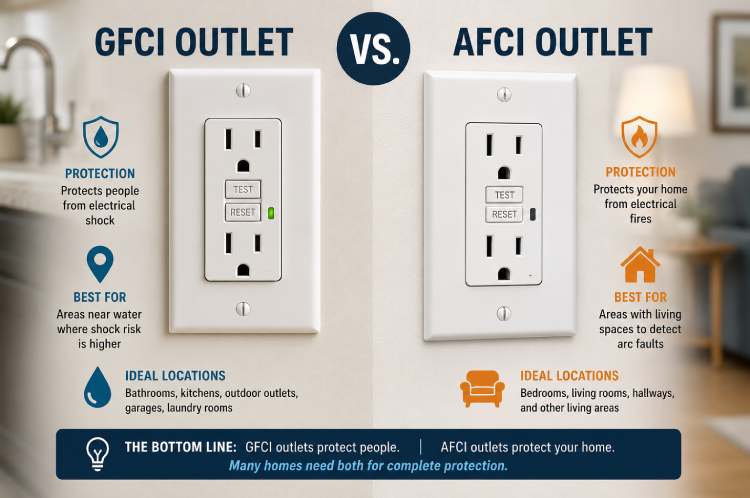
A Ground-Fault Circuit Interrupter protects people from electric shock. It constantly monitors the electricity flowing to and from a device. If even a tiny amount — as little as 4 to 6 milliamps — starts flowing somewhere it shouldn’t, such as through water or a person, the GFCI cuts power in a fraction of a second [1].
This is the outlet you want anywhere electricity and moisture might meet: bathrooms, kitchens, garages, unfinished basements, and outdoor outlets. Since GFCIs were introduced, they’ve been credited with roughly an 80% reduction in home electrocutions [2].
“I’ve pulled outlets out of older Sandy homes that had zero ground-fault protection anywhere near the kitchen sink,” Thomas says. “People don’t think about it until something goes wrong, but a GFCI is genuinely one of the cheapest pieces of insurance you can put in a house.”
What an AFCI Actually Does
An Arc-Fault Circuit Interrupter protects your house, not your skin. It’s designed to detect arc faults — the sparking that happens when wiring is damaged, pinched, chewed by rodents, or simply old and brittle — and shut the circuit down before that arcing ignites insulation or framing.
This matters more than people realize. Arc faults start more than 35,000 home fires every year in the U.S., causing over 500 deaths and $1.4 billion in property damage [3]. The Consumer Product Safety Commission estimates that proper AFCI protection could prevent roughly half of all home electrical fires [4]. That’s not a marginal safety upgrade — it’s one of the most effective fire-prevention tools available for residential wiring.
AFCIs are typically built into the breaker itself, though outlet-style versions exist too. They’re required in nearly all the rooms where people actually live: bedrooms, living rooms, dens, hallways, and kitchens.
GFCI vs. AFCI at a Glance
GFCI Outlets
- Protects against: Electric shock
- Detects: Current leaking to ground (through water or a person)
- Typical locations: Kitchens, bathrooms, garages, basements, outdoors
- Reaction time: Milliseconds
AFCI Breakers/Outlets
- Protects against: Electrical fires
- Detects: Dangerous arcing in damaged or worn wiring
- Typical locations: Bedrooms, living areas, hallways, kitchens
- Reaction time: Milliseconds, but tuned to arc signatures rather than current leakage
Where Utah Code Requires Each Today
Utah currently enforces the 2020 National Electrical Code with statewide amendments, a code cycle that’s been in effect since July 1, 2023 [5]. That means homes built or substantially remodeled under current code need GFCI protection in wet and damp locations, and AFCI protection covering most living spaces — a combined standard that, in practice, requires dual protection in rooms like kitchens and laundry areas where both moisture and heavy electrical loads are present.
Here’s the part that catches a lot of homeowners off guard: code requirements at the time of construction don’t update themselves. A home built in Midvale in the late 1990s was perfectly compliant when it was wired, but it likely has none of this protection today. Code only forces an upgrade when you’re doing new work — adding a circuit, remodeling a kitchen, finishing a basement. Otherwise, older protection (or lack of it) is grandfathered in.
This is also an area where local jurisdictions and code cycles shift over time, so if you’re planning a remodel in South Jordan or Salt Lake City, it’s worth confirming current requirements with your electrical contractor or local building department before pulling permits, rather than assuming what applied five years ago still applies today.
Common Mistakes Homeowners Make With These Outlets
Thomas sees a handful of the same issues repeatedly on service calls:
Replacing a GFCI with a standard outlet because it “kept tripping.” A nuisance trip is usually a symptom — a failing appliance, a damaged cord, or moisture intrusion — not a reason to remove the protection. Swapping it out for a regular outlet doesn’t fix the underlying problem; it just hides it.
Assuming one GFCI protects the whole house. A single GFCI outlet can protect downstream outlets on the same circuit, but only if it’s wired correctly at the first outlet in the chain. Plenty of homes have GFCI outlets installed that aren’t actually protecting anything beyond themselves.
Never testing them. Both GFCI and AFCI devices have test buttons for a reason. ESFI recommends testing monthly, but most homeowners never touch them after move-in [1].
Treating a tripping AFCI breaker as routine. Unlike a GFCI nuisance trip, a breaker that won’t reset or trips repeatedly under an AFCI is often telling you there’s real arcing happening somewhere in the wall. That’s not a “wait and see” situation.
Do You Need Both in Your Home?
In most cases, yes — and in the rooms where moisture and daily electrical use overlap, like kitchens, you typically need both protections working together. Combination AFCI/GFCI devices exist specifically for this overlap, giving you shock and fire protection from a single breaker or receptacle.
If your home predates current code — which applies to a large share of houses in Sandy, Draper, Midvale, and the surrounding area — it’s worth having an electrician walk through and identify which rooms have which protections, rather than guessing based on whether an outlet has a test button.
Signs Your Home May Be Missing Protection
A few quick things worth checking: outlets near sinks or in the garage that don’t have test/reset buttons, a breaker panel where none of the breakers are labeled AFCI, frequent flickering or warm outlet covers, or a home built before the late 1990s that hasn’t had an electrical update since. None of these automatically mean something’s wrong, but they’re worth a professional look.
When to Call a Licensed Electrician
Installing or upgrading GFCI and AFCI protection sounds simple, but it involves identifying the circuit wiring, confirming proper grounding, and ensuring devices are installed at the correct point in the circuit to protect what they’re supposed to protect. Get it wrong, and you can end up with a device that looks like it’s working but isn’t protecting anything downstream.
If you’re in Sandy, Draper, Midvale, South Jordan, or Salt Lake City and aren’t sure what protection your home currently has, Westover Electric can walk through your panel and outlets and tell you plainly what’s covered, what isn’t, and what it would take to bring things up to current standards. No guesswork, no upsell — just a clear picture of where your home stands. Reach out today. Learn more about Westover Electric, the trusted electrician in Sandy, UT.
Frequently Asked Questions
Can I install a GFCI or AFCI outlet myself?
Replacing a single outlet is within reach for some DIYers, but confirming it’s wired correctly to protect the rest of the circuit is where most mistakes happen. A licensed electrician can verify the whole circuit, not just the outlet.
Why does my AFCI breaker keep tripping?
It could be a faulty appliance, but repeated trips can also indicate real arcing in the wiring. Don’t ignore it.
Are GFCI and AFCI required in every Utah home?
Requirements apply at the time of construction or remodel under current code. Older homes aren’t automatically required to upgrade unless work is being done on that circuit.
Sources
- Electrical Safety Foundation International, “Home Safety,” https://www.esfi.org/home-safety/
- Electrical Safety Foundation International, “Home Safety” (GFCI electrocution reduction data), https://www.esfi.org/home-safety/
- Electrical Safety Foundation International, “AFCIs: Protecting Your Home From Fires,” https://www.esfi.org/afcis-protecting-your-home-from-fires/
- Electrical Safety Foundation International, “Home Safety” (CPSC AFCI estimate), https://www.esfi.org/home-safety/
- Utah State Construction Code adoption record, https://up.codes/codes/utah