Basement finishing electrical requirements in Murray, Utah, catch more homeowners off guard than almost any other part of the project. You’ve got the layout planned, the contractor lined up, and you’re ready to frame walls and start building — and then someone mentions permits, panel capacity, GFCI protection, and AFCI breakers, and suddenly the whole timeline looks a lot more complicated than you expected.
I’ve done the electrical on a lot of basement finishes across Salt Lake County. Murray, Millcreek, South Salt Lake, the Avenues — the same questions come up on nearly every job. How many circuits do I need? Does my panel have room? What does the inspector actually check? When does an electrician need to be involved?
This post answers all of it, in plain language, before you pull a single permit or move a single piece of drywall.
Why Basement Electrical Work Is Different From the Rest of Your Home
Finishing a basement isn’t the same as remodeling a kitchen or adding a bathroom upstairs. Basements in Utah are treated as new habitable space the moment you start finishing them, which means the electrical work has to meet current code — not whatever was acceptable when the house was built.
Because basements sit below grade, they involve different considerations than main-level construction. Ceiling height, insulation, electrical layout, plumbing placement, and fire safety standards must all be addressed during planning — not halfway through the project. Wikipedia
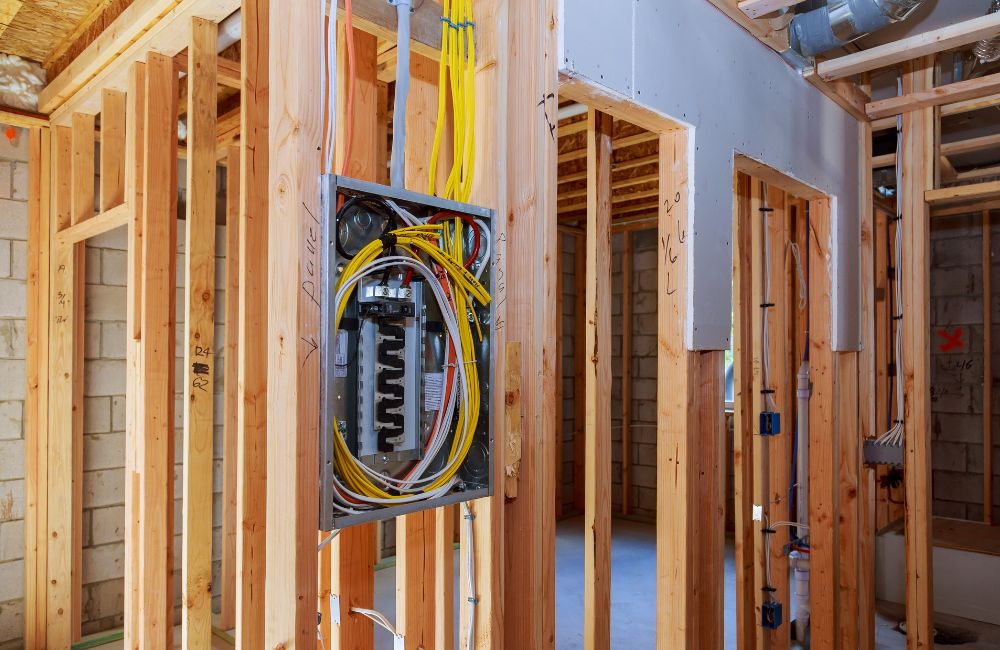
That last part matters. Electrical rough-in must occur before the walls are closed. Electrical work must be completed to code and inspected before walls are closed. If you frame and drywall before the electrical inspection passes, you’ll have to tear those walls back out. We’ve seen it happen. It’s expensive and completely avoidable. Wikipedia
Do You Need a Permit for Basement Electrical Work in Murray or Salt Lake City?
Yes — without exception. Anytime you add, relocate, or rewire outlets, fixtures, or light switches, an electrical permit is required. In Salt Lake County, this ensures your new basement wiring meets National Electrical Code (NEC) standards — reducing fire risk and ensuring safe load management. Vivint
Most Utah city permits take one to three weeks to process. Factor that into your project timeline from day one. Skipping the permit doesn’t save time — it creates problems you’ll pay for later. Homeowner’s insurance policies may not cover damage caused by unpermitted electrical or plumbing work. And when you eventually sell, unpermitted basement work is one of the first things a buyer’s inspector flags. HippoVivint
A homeowner in South Jordan finished his 1,000-square-foot basement himself without pulling permits. When he listed his home three years later, the appraiser noted that the inspection records were missing. He was forced to tear out sections of drywall so inspectors could verify electrical and plumbing safety — adding $8,000 in rework costs and delaying the sale for over a month. Vivint
Pull the permit. It protects your family and your investment.
What the Utah Code Actually Requires for Basement Electrical
Utah follows the International Residential Code (IRC) with state-specific amendments. Utah adopted the 2021 International Residential Code as its residential standard. Here’s what that means for your basement finish in practical terms: UpCodes
Outlet Spacing
Receptacles shall be installed so that no point measured horizontally along the floor line of any wall space is more than 6 feet from a receptacle outlet. In plain English: you need an outlet at least every 12 feet along any wall so that you’re never more than 6 feet from one. Most finished basement rooms will need more than you think — especially if you’re planning a home office, media room, or gym. westoverelectric
GFCI and AFCI Protection
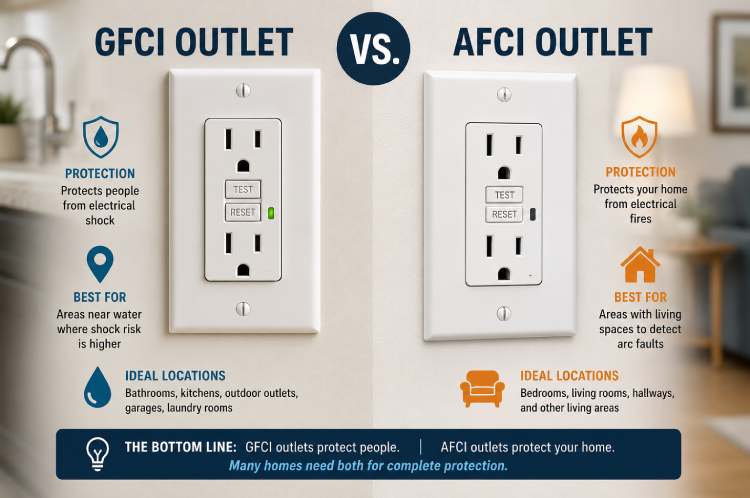
Circuits in basements often need arc-fault or ground-fault protection. GFCI (Ground Fault Circuit Interrupter) protection is required anywhere near water — wet bars, bathrooms, and laundry areas. AFCI (Arc Fault Circuit Interrupter) protection is required on bedroom circuits and most general-purpose circuits in finished living spaces. These aren’t optional — they’re code, and inspectors check for them. Wikipedia
Dedicated Circuits
If your basement includes a home theater, wet bar, workshop, or home gym with large equipment, those spaces often require dedicated circuits. A dedicated circuit serves only one outlet or appliance — it doesn’t share a breaker with other loads. Trying to run a bar fridge, a 65-inch TV, and a gaming setup all on one general circuit is how breakers trip at the worst possible moment.
Lighting Requirements
A switch-controlled lighting outlet must be provided in hallways, stairways, exits, and in each room. Every finished room needs a switched light — not just a plug-in lamp. Stairways especially need proper lighting, and Utah code is specific about it. Guardian Protection
Smoke and Carbon Monoxide Detectors
Provide a smoke detector for each bedroom, guest room, in the access area to all bedrooms, and at least one smoke detector on each floor. Carbon monoxide detectors are required on each level of the home. These need to be hardwired and interconnected in most cases — a battery-only detector doesn’t satisfy code on a new finish unless specific exceptions apply. Guardian Protection
Panel Capacity: The Question Most Homeowners Skip Until It’s Too Late
Before adding a single circuit to your basement, your electrical panel needs to have room for it. This is where many Murray and Salt Lake City basement projects run into unexpected costs — and where early planning saves real money.
A finished basement adds a load that your panel must manage. To comply with basement circuit requirements, an electrical panel upgrade may be necessary. Wikipedia
Older homes in Murray and the Salt Lake Valley — especially those built in the 1960s through 1980s — often came with 100-amp service. That was adequate at the time. Today, with central air conditioning, modern appliances, and a fully finished basement, adding multiple new circuits often means 100 amps is not enough. A panel that’s already near capacity before the basement project starts is a problem that needs to be solved before rough-in begins — not after the inspector shows up.
The time to assess your panel is before the project starts, not halfway through it. At Westover Electric, panel evaluation is part of every basement electrical consultation we do in Murray and Salt Lake City.
What the Electrical Inspection Actually Covers
Most basement finish projects in Salt Lake County require at least two electrical inspections: a rough-in inspection before walls are closed, and a final inspection once everything is complete. Here’s what inspectors are checking at each stage:
Rough-In Inspection
- Correct wire gauge for each circuit type
- Proper box fill — meaning the right size junction and outlet boxes for the number of wires inside
- AFCI and GFCI circuit identification
- Panel capacity and breaker labeling
- Smoke and CO detector rough-in locations
Final Inspection
- All devices are installed and functional
- GFCI and AFCI breakers tested and verified
- Smoke and CO detectors are hardwired and interconnected
- Switch-controlled lighting in every room and hallway
- Panel directory updated and labeled
Failing either inspection means rescheduling, and in some cases, tearing out work to fix what’s behind the walls. Getting it right the first time starts with hiring a licensed electrician who knows what inspectors look for in Salt Lake County.
The Honest Answer on DIY Basement Electrical in Utah
Some homeowners want to do their own electrical work on a basement finish. Utah law allows a homeowner to perform electrical work on their primary residence — but there are conditions. You still have to pull a permit. The work still has to be inspected. And it still has to meet code.
What the law doesn’t allow is having an unlicensed friend, a handyman, or an unqualified contractor do the work for you. That’s where legal and insurance exposure begins. If something goes wrong — a fire, a failed inspection, a denied claim — the homeowner is held liable.
For most homeowners, a basement finish is one of the largest investments they’ll make in their home. The electrical is not the place to cut corners.
Frequently Asked Questions
Do I need an electrical permit to finish my basement in Murray or Salt Lake City?
Yes, always. Any electrical work involving new wiring, outlets, fixtures, or panel modifications requires an electrical permit in Salt Lake County. Unpermitted work can void your homeowner’s insurance, complicate a future home sale, and result in costly tear-outs to satisfy inspectors.
How many circuits does a finished basement typically need?
It depends on the layout and how the space will be used. Still, most finished basements in Murray and Salt Lake City require a minimum of four to six new circuits — general lighting, general outlets, dedicated circuits for any wet bar or laundry, and bedroom circuits with AFCI protection if sleeping areas are included. A licensed electrician can calculate the exact load and circuit requirements before work begins.
What is AFCI protection, and why does my basement need it?
AFCI stands for Arc-Fault Circuit Interrupter. It’s a type of breaker that detects dangerous electrical arcing — the kind that can start fires inside walls without tripping a standard breaker. Utah code requires AFCI protection on bedroom circuits and most general-purpose circuits in finished living spaces. It’s one of the most important safety upgrades in the modern electrical code.
Does finishing a basement require a panel upgrade?
Not always, but frequently — especially in older Murray and Salt Lake City homes that were built with 100-amp service. A panel that’s already near capacity before the basement project starts won’t have room for the additional circuits a finished space requires. A licensed electrician can assess your current panel capacity and tell you upfront whether an upgrade is needed.
How long does it take to get an electrical permit in Salt Lake County?
Most permit applications in Salt Lake County are processed within one to three weeks. Working with a licensed electrical contractor who submits complete documentation typically speeds up the process. Westover Electric handles all permitting for every project we take on.
Does Westover Electric handle basement electrical work in Murray and Salt Lake City?
Yes. Westover Electric serves Murray, Salt Lake City, Millcreek, Sandy, Midvale, South Jordan, and throughout Salt Lake County. We handle everything from panel evaluation and circuit planning to full electrical rough-in, inspections, and final. Call (385) 732-3182 or request a free estimate online.
Looking for a Master Electrician in Murray or Salt Lake City?
When it comes to basement finishing electrical requirements in Murray, Utah, experience and credentials matter. Thomas Westover is a licensed Master Electrician — Utah’s highest level of electrical certification — with thousands of hours of verified field experience handling exactly this kind of work across Salt Lake County. As a fully licensed and insured electrical contractor serving Murray, Salt Lake City, Sandy, Midvale, South Jordan, and Draper, Westover Electric handles every phase of basement electrical from panel evaluation through final inspection. All permits are pulled. All work is done to code. Estimates are always free. If you’re planning a basement finish and want the electrical done right the first time, that’s exactly the kind of call we’re built for.
Sources & References
- National Fire Protection Association (NFPA) — NFPA 70 National Electrical Code: https://www.nfpa.org/codes-and-standards/nfpa-70-standard-development/70
- Salt Lake City Building Services — Current Building Codes: https://www.slc.gov/buildingservices/current-building-codes/
- Saratoga Springs, UT — Basement Permit Requirements: https://www.saratogasprings-ut.gov/225/Obtaining-a-Basement-Permit
- Utah Building Code (PermitPlace) — 2021 IRC Adoption: https://permitplace.com/state/utah-permit-building-code-and-licensing-information/
- Basements Etc — Permit Requirements for Basement Finishing in Utah: https://basementfinishing.com/permit-requirements-for-basement-finishing-in-utah-and-why-skipping-them-can-cost-you/
- ElkStone Basements — Basement Zoning & Code Compliance Utah: https://elkstonebasements.com/basement-zoning-code-compliance-what-you-need-to-know-in-utah/
- CCS of Utah — Basement Electrical Code Compliance Utah: https://ccsofutah.com/basement-electrical-code-compliance-utah/
- Utah Basement Specialists — Basement Code Requirements: https://utahbasementspecialists.com/utah-basement-code-requirements/
- Utah Division of Occupational and Professional Licensing (DOPL): https://commerce.utah.gov/dopl/electrical/